Why You'll Love This
Isaacson had access to Leonardo's actual notebooks — 7,200 pages of drawings, to-do lists, and half-finished theories — and the portrait that emerges is stranger and more human than the myth.
- Great if you want: to understand genius as a practice, not a gift
- The experience: expansive and unhurried — dense with detail, best read slowly
- The writing: Isaacson structures biography like intellectual archaeology, tracing ideas across decades
- Skip if: you want narrative momentum — this is a deep dive, not a page-turner
About This Book
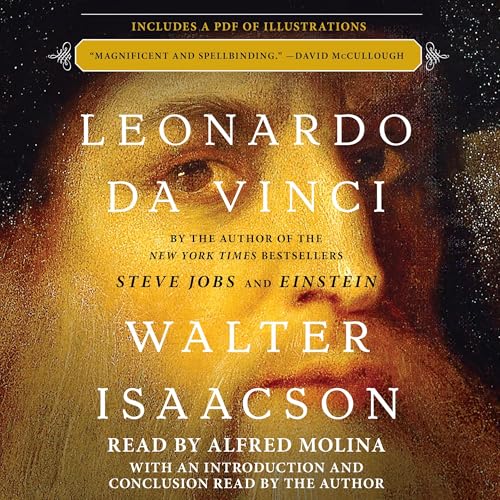
What would it mean to truly see the world — not just to glance at it, but to study a woodpecker's tongue, trace the spiraling currents of water, or spend years understanding the precise muscles behind a human smile? Walter Isaacson's biography of Leonardo da Vinci pursues that question with genuine urgency. Drawing on Leonardo's voluminous personal notebooks, Isaacson reconstructs a mind so restlessly curious that painting felt like only one expression of it. The book makes the case that Leonardo's greatness wasn't simply innate — it was cultivated, and that changes how we think about creativity itself.
Isaacson writes with the clarity and momentum of a storyteller who respects his readers' intelligence without overwhelming them in scholarly apparatus. He moves fluidly between Leonardo's art and his obsessive scientific investigations, letting each illuminate the other so that the Mona Lisa and a dissected cadaver end up feeling like chapters in the same long argument. At 600 pages, the book earns its length — each digression into anatomy or hydraulics deepens your sense of a man who couldn't look at anything without needing to understand it completely.
Browse Related Lists
More by Walter Isaacson

Elon Musk
688 pages

Steve Jobs

Einstein: His Life and Universe
675 pages

The Innovators: How a Group of Hackers, Geniuses and Geeks Created the Digital Revolution
542 pages

Benjamin Franklin: An American Life
586 pages

Kissinger: A Biography
896 pages