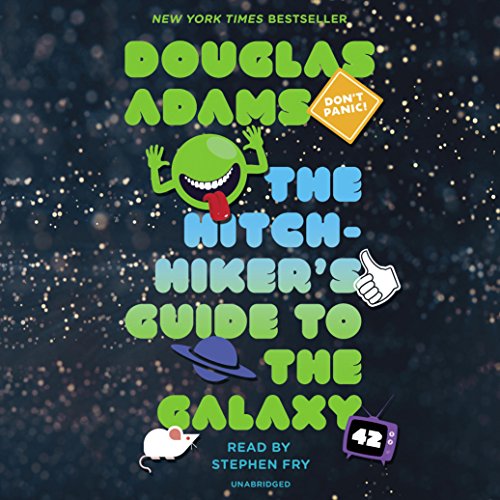
The Hitchhiker's Guide to the Galaxy
Hitchhiker's Guide to the Galaxy • Book 1
by Douglas Adams
Why You'll Love This
Adams turned the destruction of Earth into a punchline — and somehow that makes the whole universe feel funnier and stranger than it did before.
- Great if you want: absurdist comedy that also smuggles in genuine philosophy
- The experience: breezy and anarchic — reads like it's actively enjoying itself
- The writing: Adams builds jokes with structural precision, then detonates them three paragraphs later
- Skip if: you want plot momentum — the book meanders cheerfully and unapologetically
About This Book
On an otherwise unremarkable Thursday morning, Arthur Dent loses his house, his planet, and any reasonable expectation that the universe makes sense — all before lunch. Douglas Adams takes the oldest premise in science fiction, the lone human adrift in a vast cosmos, and strips away every scrap of heroism and cosmic significance, leaving something far more honest: a bewildered everyman clutching a cup of tea while reality collapses around him. The result is a story about smallness, absurdity, and the faint comfort of having at least one friend who knows what's going on, even if that friend isn't entirely human.
What makes this book such a singular reading experience is Adams's prose, which operates like a comedian doing philosophy with a straight face. His sentences build to punchlines buried three clauses deep, his footnotes contain entire arguments, and his digressions are often more illuminating than the plot they interrupt. The novel doesn't satirize science fiction so much as it uses science fiction as a delivery system for genuinely strange ideas about meaning, bureaucracy, and the cruel indifference of large institutions. Every paragraph rewards close attention, and rereading it only reveals how much you missed the first time.
