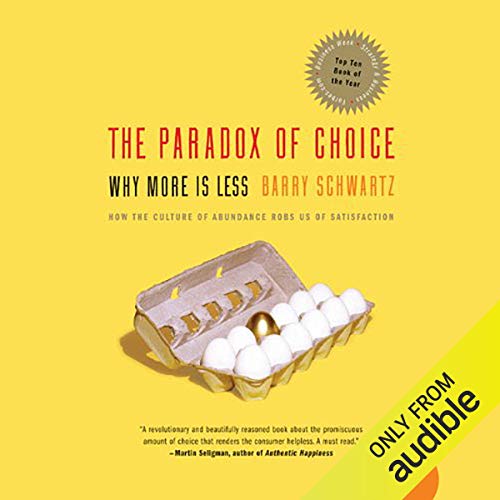
The Paradox of Choice: Why More Is Less
by Barry Schwartz
Why You'll Love This
More options should mean more freedom — Schwartz argues it's actually making you miserable, and the evidence is hard to dismiss.
- Great if you want: psychology that reframes everyday frustration into something explainable
- The experience: brisk and accessible — reads more like a conversation than a lecture
- The writing: Schwartz anchors big ideas in mundane examples — jeans, menus, retirement plans
- Skip if: you want deep academic rigor — the research is real but lightly cited
About This Book
We live in a culture that treats choice as freedom and abundance as progress — yet most of us have stood paralyzed in a grocery aisle or second-guessed a perfectly good decision simply because other options existed. Barry Schwartz argues that this isn't weakness or ingratitude; it's an inevitable psychological consequence of having too much to choose from. Drawing on behavioral economics and social psychology, he makes a provocative case that the relentless expansion of options doesn't liberate us — it burdens us with anxiety, regret, and the nagging sense that we could always have done better.
What makes this book genuinely satisfying to read is how Schwartz balances rigorous research with sharp, relatable examples — the cereal aisle, the retirement plan, the doctor's office. He has a gift for translating academic concepts into clear, conversational prose without dumbing them down, and his structure builds steadily from diagnosis to implication. The book earns its argument rather than just asserting it, which means readers finish not just persuaded but equipped with a new lens for understanding their own daily frustrations.