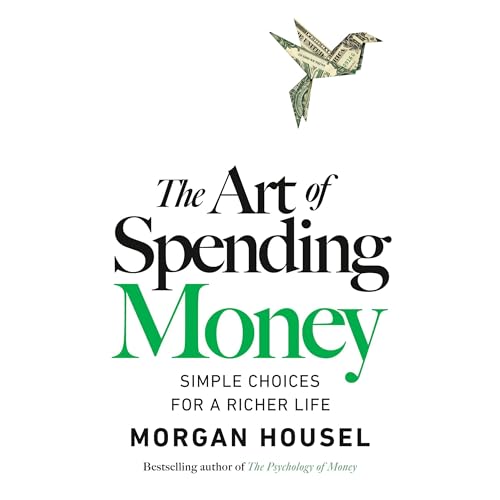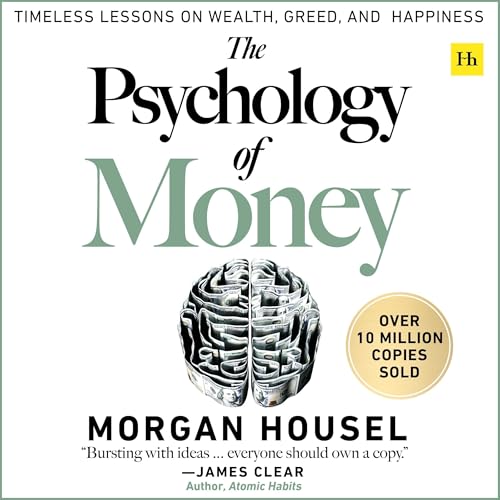
The Psychology of Money
by Morgan Housel, Jen Sincero, Rob Moore
Narrated by Chris Hill
Why Listen to This Audiobook?
Three personal finance books that usually clash in tone somehow click together when Chris Hill reads them like he's had all three authors over for dinner.
- Great if you want: a mindset reset on money without dry spreadsheet thinking
- Listening experience: conversational and accessible — feels like a long podcast binge
- Narration: Hill's grounded delivery bridges Housel's quiet logic and Sincero's brashness
- Skip if: you want one author's voice — three books means three tonal shifts
About This Audiobook
Money serves as one of life's most emotionally charged subjects, yet financial education traditionally treats it as pure mathematics divorced from human psychology. Three prominent voices in personal finance examine how behavioral patterns, deeply rooted beliefs, and cognitive biases shape every monetary decision people make. Rather than offering formulaic investment strategies, these authors explore the gap between rational financial theory and the messy reality of human nature. They dissect why intelligent individuals make poor money choices, how childhood experiences influence adult spending habits, and why understanding personal psychology proves more valuable than mastering complex financial instruments.
Chris Hill delivers these intertwined perspectives with remarkable clarity, seamlessly transitioning between each author's distinct voice and methodology. His measured pacing allows listeners to absorb complex psychological concepts without feeling overwhelmed, while his conversational tone makes abstract financial principles feel accessible and immediately applicable. The audio format particularly enhances the storytelling elements woven throughout each section, transforming potentially dry economic theory into engaging narratives about real people and their relationship with wealth. Hill's performance transforms what could be a dense academic treatment into an intimate exploration of money's profound psychological dimensions.