Best Philip K. Dick Books
Philip K. Dick didn't write science fiction so much as philosophical vertigo dressed up as pulp. His best work — Do Androids Dream of Electric Sheep?, Ubik, The Man in the High Castle — keeps pulling the rug out from under you: reality shifts, identities dissolve, and the machinery of power turns out to be far stranger than anyone suspected. His prose is fast and unpretentious, built for ideas rather than atmosphere, which makes the paranoia hit harder. Dick was obsessed with a handful of questions — what makes someone human, who controls what we believe is real, whether consciousness itself can be trusted — and he attacked them from every angle across his career. For readers who want science fiction that unsettles rather than reassures, Dick is essential.
Where to Start with Philip K. Dick
- Best entry point → Ubik
- Best standalone → The Complete Short Stories
- Start the Blade Runner series → Do Androids Dream of Electric Sheep?
- What readers keep coming back to → The Man in the High Castle
- Highest rated by readers → The Exegesis of Philip K. Dick
Best Philip K. Dick Books
- 1
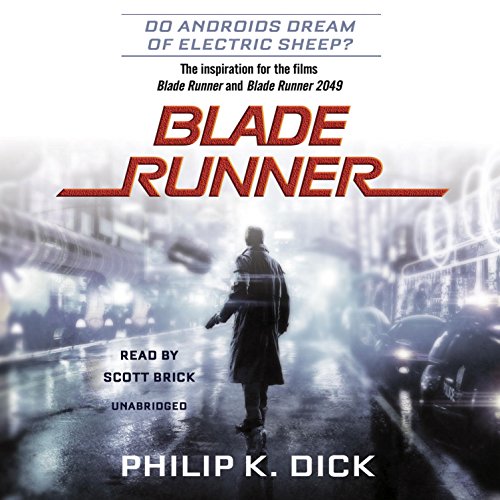
Do Androids Dream of Electric Sheep?
Blade Runner
More about this pick
In a world where owning a real animal is the ultimate status symbol, android hunters question the line between human and artificial consciousness. Dick's paranoid vision inspired Blade Runner.
★ 4.09 Goodreads (517.9K ratings) - 2

Ubik
More about this pick
Glen Runciter is dead—or maybe everyone else is—as reality becomes increasingly unreliable and messages from the deceased boss multiply. Dick's most unsettling novel questions the nature of life, death, and consciousness itself.
★ 4.11 Goodreads (124.5K ratings) - 3

The Complete Short Stories
by Philip K. Dick, Jonathan Lethem, Chris Malbon, Georgia Hill, Anna Millais, Jeremy Wilson, Raisa Álava, Chris Thornley
More about this pick
Dick's complete short fiction spans from android servants to time-traveling assassins, exploring every corner of his reality-questioning imagination across 118 stories.
★ 4.17 Goodreads (9.7K ratings) - 4

The Minority Report and Other Classic Stories
More about this pick
These essential Dick stories explore precognition, false memories, and shifting realities with the philosophical depth that made him science fiction's most influential paranoid visionary.
★ 4.11 Goodreads (14.8K ratings) - 5

- 6

Martian Time-Slip
More about this pick
Ten-year-old Manfred's schizophrenia may be humanity's window into Mars' future, turning him from deportation candidate to political pawn. Dick's exploration of mental illness and time perception feels decades ahead of its time.
★ 3.78 Goodreads (14.6K ratings) - 7

The Penultimate Truth
More about this pick
Dick imagines a world where underground masses are fed fake war footage while elites enjoy peace above. The novel asks whether comfortable lies trump devastating truths.
★ 3.78 Goodreads (11.5K ratings) - 8

The Man in the High Castle
More about this pick
Dick's alternate history imagines 1962 America divided between Nazi and Japanese occupation, where survivors navigate daily life under fascist rule while questioning the nature of reality itself.
★ 3.59 Goodreads (237.7K ratings) - 9

The Game-Players of Titan
More about this pick
Dick turns post-alien-invasion Earth into a cosmic casino where humans gamble away cities, spouses, and sanity in increasingly surreal games with telepathic slugs.
★ 3.65 Goodreads (5.1K ratings) - 10

The World Jones Made
More about this pick
Floyd Jones can see the future, but his real power lies in making people dream again in a society where dreaming has been outlawed—even when those dreams might destroy everything.
★ 3.65 Goodreads (4.1K ratings) - 11

Our Friends From Frolix 8
More about this pick
Menial worker Nick and elite ruler Willis both pursue black market revolutionary Charlotte in Dick's fast-paced exploration of love across class warfare.
★ 3.58 Goodreads (3.6K ratings) - 12

The Man Who Japed
More about this pick
After nuclear war, society rebuilds itself around oppressive morality enforced by tiny surveillance robots—until Allen Purcell gets the power to change everything.
★ 3.58 Goodreads (3.3K ratings) - 13

Great Classic Science Fiction
Great Classic Stories (BBC Audio)
by H.G. Wells, James H. Schmitz, Stanley G. Weinbaum, Philip K. Dick, Frank Herbert, Fritz Leiber, Andre Norton
More about this pick
Wells' 'The Door in the Wall' joins Dick's 'The Defenders' and five other classics spanning sci-fi's golden age. Anthology showcasing genre evolution from pulp to sophistication.
★ 3.42 Goodreads (522 ratings)